A Brief History of Artificial Intelligence
From the Dartmouth Workshop to Deep Learning, a whirlwind tour of the key milestones, thinkers, and breakthroughs that have shaped the field of AI.
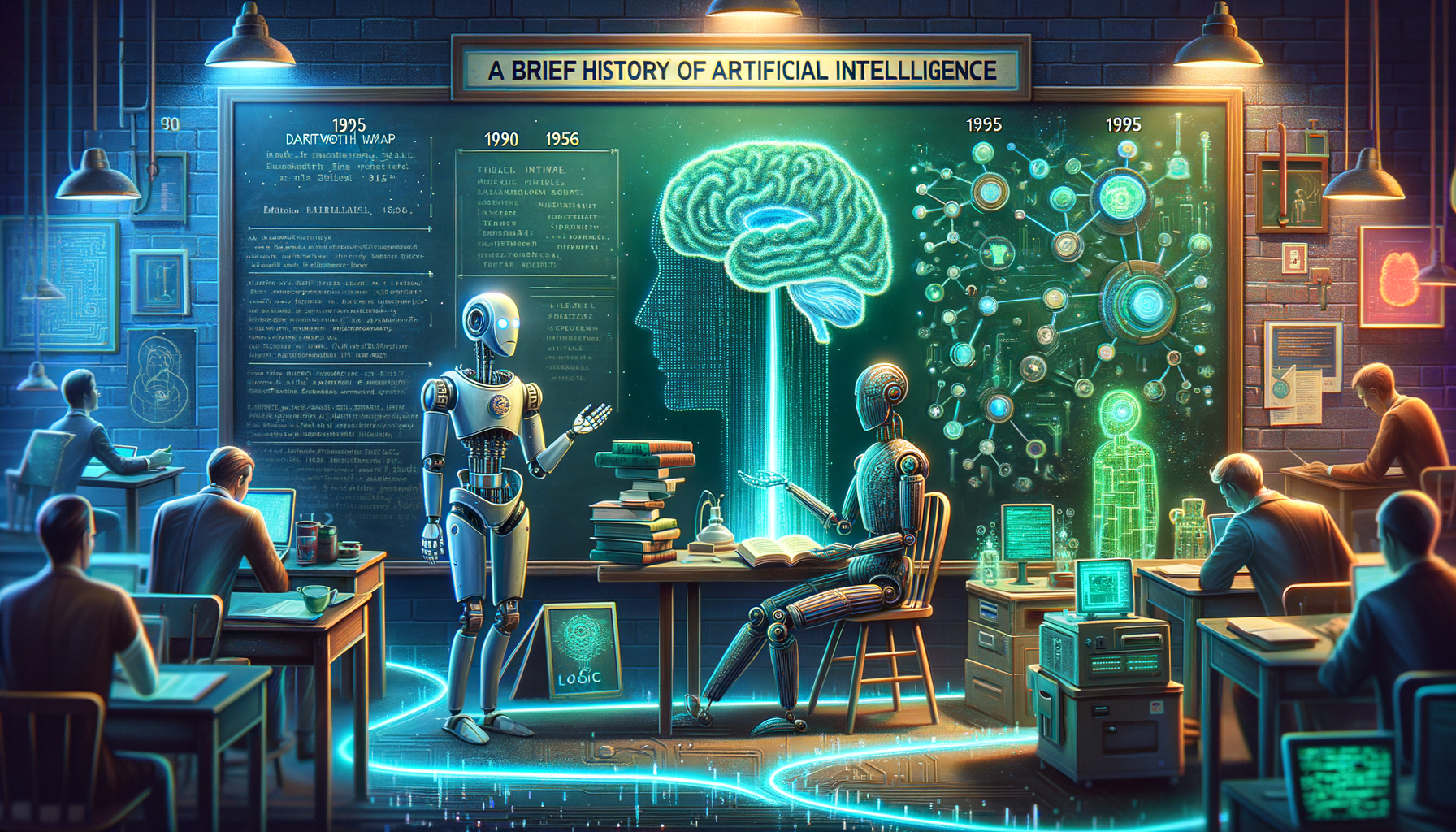
From Turing to Transformers: A Journey Through AI's Evolution
The story of artificial intelligence is a captivating saga of human ambition, groundbreaking discoveries, and persistent philosophical inquiry. From its earliest conceptual stirrings to the sophisticated models that define our present, AI has continually reshaped our understanding of intelligence itself. This post embarks on a whirlwind tour, tracing the pivotal moments and influential minds that have forged the path of AI.
The Dawn of a New Era: The 1940s and 1950s
The intellectual bedrock of AI was laid in the mid-20th century, a period brimming with foundational theoretical work. A crucial early stride came in 1943, when Warren McCulloch and Walter Pitts published their seminal paper, "A Logical Calculus of the Ideas Immanent in Nervous Activity." This groundbreaking work introduced the first mathematical model of a neural network, effectively laying the groundwork for both cybernetics and the subsequent development of artificial neural networks.
However, it was Alan Turing's visionary 1950 paper, "Computing Machinery and Intelligence," that truly ignited the nascent field. Turing famously posed the question, "Can machines think?" and introduced the now-iconic "imitation game," widely known as the Turing Test. This test proposed a practical method for assessing a machine's ability to exhibit intelligent behavior indistinguishable from that of a human. Turing's insights remain a cornerstone of AI philosophy and research to this day.
The term "artificial intelligence" itself was officially coined in 1956 at a landmark workshop held at Dartmouth College. Orchestrated by John McCarthy, this pivotal gathering united the field's pioneering figures, including Marvin Minsky, Nathaniel Rochester, and Claude Shannon. The Dartmouth workshop is universally regarded as the formal birth of AI as a distinct academic discipline.
The First Wave and the AI Winter: The 1960s and 1970s
The years immediately following the Dartmouth workshop were characterised by fervent optimism and rapid advancements. Early triumphs, such as Arthur Samuel's checkers-playing program, which demonstrated an ability to learn from its own mistakes, and the Logic Theorist, a program capable of proving mathematical theorems, fueled a widespread belief that truly intelligent machines were just on the horizon.
Yet, this initial euphoria was soon tempered by the sheer complexity of the challenges ahead. The ambitious goals often outstripped the available computational power and theoretical understanding. This led to the infamous "AI winter" of the 1970s, a period marked by significantly reduced funding and waning public interest. Influential critiques, such as the Lighthill Report in the UK, highlighted the lack of substantial breakthroughs, contributing to the downturn.
The Resurgence of Expert Systems: The 1980s
The 1980s witnessed a significant resurgence of interest in AI, largely driven by the emergence of "expert systems." These specialised AI programs were meticulously designed to emulate the decision-making prowess of human experts within narrowly defined domains. This practical application spurred a considerable boom in the AI industry, with companies like Digital Equipment Corporation and Symbolics actively developing and marketing these sophisticated systems.
Further impetus came from Japan's ambitious Fifth Generation Computer Systems Project, launched in 1982. This visionary initiative aimed to engineer a new generation of computers specifically tailored for parallel processing and advanced AI applications, pushing the boundaries of what was computationally possible.
The Machine Learning Revolution and Deep Learning: The 1990s and 2000s
The 1990s heralded a pivotal shift towards machine learning, emphasising statistical methods and leveraging the increasing availability of larger datasets. A monumental achievement during this era was the defeat of world chess champion Garry Kasparov by IBM's Deep Blue computer in 1997. This highly publicised event powerfully demonstrated AI's burgeoning strategic capabilities on a global stage.
The 2000s and 2010s were profoundly shaped by the ascendance of deep learning, a transformative subfield of machine learning that utilises neural networks with multiple layers (hence, "deep"). Breakthroughs in this domain, notably the development of Deep Belief Networks in 2006 by Geoffrey Hinton, catalysed rapid advancements across various fields, including image recognition, speech processing, and natural language understanding.
The Age of Large Language Models: The 2020s and Beyond
The current decade is unequivocally defined by the explosive rise of large language models (LLMs), exemplified by systems like OpenAI's GPT-3 and Google's LaMDA. These colossal models, meticulously trained on unprecedented volumes of text and code, have showcased astonishing abilities in generating remarkably human-like text, translating languages with impressive fluency, and crafting diverse forms of creative content.
The history of AI has been a dynamic interplay of soaring optimism and periods of pragmatic reassessment. Yet, the field continues its relentless evolution, accelerating at an unprecedented pace. Its profound impact on technology, society, and our very conception of intelligence ensures that the journey of AI remains one of the most compelling narratives of our time.
References
- McCulloch, W. S., & Pitts, W. (1943). A logical calculus of the ideas immanent in nervous activity. The bulletin of mathematical biophysics, 5(4), 115-133.
- Turing, A. M. (1950). Computing machinery and intelligence. Mind, LIX(236), 433-460.
- Samuel, A. L. (1959). Some studies in machine learning using the game of checkers. IBM Journal of research and development, 3(3), 210-229.
- Newell, A., & Simon, H. A. (1956). The logic theory machine—A complex information processing system. IRE Transactions on information theory, 2(3), 61-79.
- Hinton, G. E., Osindero, S., & Teh, Y. W. (2006). A fast learning algorithm for deep belief nets. Neural computation, 18(7), 1527-1554.
Written by
Ben Colwell
As a Senior Data Analyst / Technical Lead, I’m expanding into AI engineering with a strong commitment to responsible AI practices that drive both innovation and trust.
Related Posts
July 17, 2024
The Ethics of Artificial Sentience
If we create a truly sentient AI, what are our moral obligations to it? We explore the thorny ethical landscape of machine rights and synthetic suffering.

May 21, 2024
The Ghost in the Machine
Revisiting Gilbert Ryle's critique in the age of large language models and neural networks.